
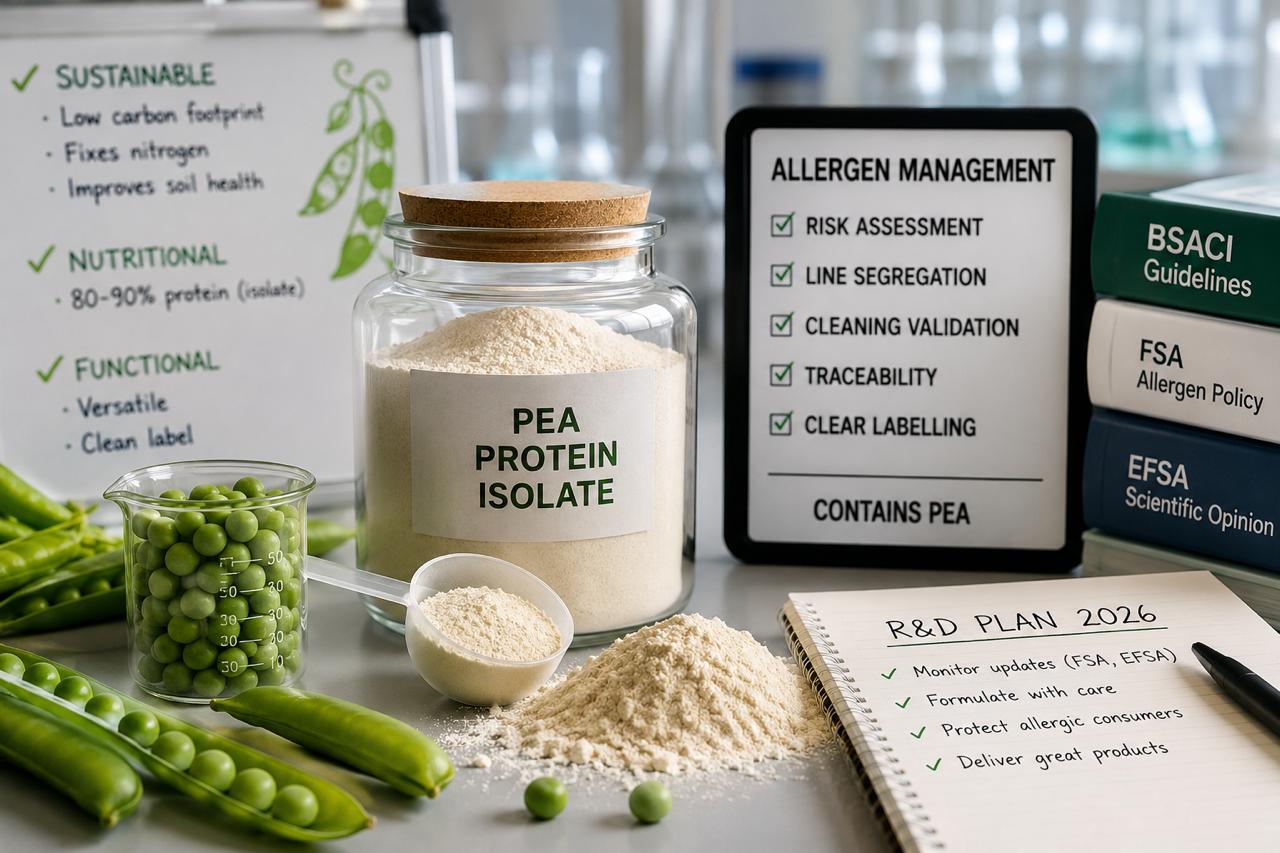
I like peas. Sincerely. Almost 9,000 years of domestication in the Fertile Crescent, a protein isolate concentrated at 80-90%, a carbon footprint much lighter than soy, a crop that fixes its own nitrogen and leaves the field richer than it found it. For an agronomist as much as for a formulator, it is a rare gift.
And yet, over the past few months, two rumours have been circulating through trade-show corridors and some British LinkedIn threads. The first: pea protein is supposedly about to receive an E number. The second: it is supposedly about to be classified as a regulated allergen. Both are presented as imminent. I preferred to go back to the sources.
What is documented
On allergy, yes, pea is under scrutiny, and for real reasons. The British Society for Allergy and Clinical Immunology (BSACI) has publicly called for pea protein to be highlighted on labels in the United Kingdom. The logic is clear: an 85% isolate is not the same as a whole garden pea. In concentrated form, it can trigger faster and more severe reactions in allergic consumers.
The Allergy Vigilance Network recorded around 413 cases of anaphylaxis between 2002 and 2023 linked to emerging allergens, including pea, lentil and buckwheat, with two reported deaths. These are not signals to dismiss lightly.
On the regulatory side, the UK Food Standards Agency recognises the concern and is working with BSACI on hidden and emerging allergens. But it also states explicitly that, at this stage, it does not intend to add pea to the list of the 14 major allergens. Any change would require robust evidence and public consultation. The debate is open, not settled.
The E-number rumour
The rumour that pea protein is about to receive an E number does not stand up well to the regulatory texts. E numbers are assigned to additives with a specific technological function, such as emulsifying, gelling or preserving. They are not designed for whole functional proteins as such.
EFSA did evaluate a concentrated pea fibre, FIPEA, in 2025 for use as a food additive. But that is the fibre, not the protein. Confusing the two appears to be feeding part of the background noise.
What I would leave as rumour
In public sources, I found no official publication announcing an imminent E number for pea protein, nor any UK regulatory timetable for classifying it as a major allergen. The hearsay is circulating. The text does not follow, at least not yet. And the gap between the two is exactly where our industry either gains or loses credibility.
What I would do in R&D
Starting today, I would treat pea as an operational allergen: line segregation, cleaning validation and documented traceability. What BSACI is asking for is already standard practice for many serious brands.
I would also declare pea clearly in the ingredient list. An honest contains pea statement avoids a mistake that no press release can repair.
Finally, I would follow EFSA and FSA publications rather than anxiety-driven LinkedIn threads. It is more austere and slower. It is also where the decision will eventually land.
Bertrand Russell said that it is better to aim at perfection and miss it than to aim at imperfection and hit it. I would add: above all, it is better to aim at data than at rumour. Pea remains a remarkable raw material. It deserves better than hearsay, and allergic consumers deserve better than waiting passively.
Sources consulted
- BSACI — Pea protein and food allergy labelling
- Food Standards Agency — allergen guidance for food businesses and DHSC parliamentary response
- Allergy UK — Reactions to Pea Protein
- Allergy Vigilance Network — 2002-2023 study on anaphylaxis cases
- EFSA Journal — Safety evaluation of pea fibre concentrate (FIPEA) as food additive, 2025