
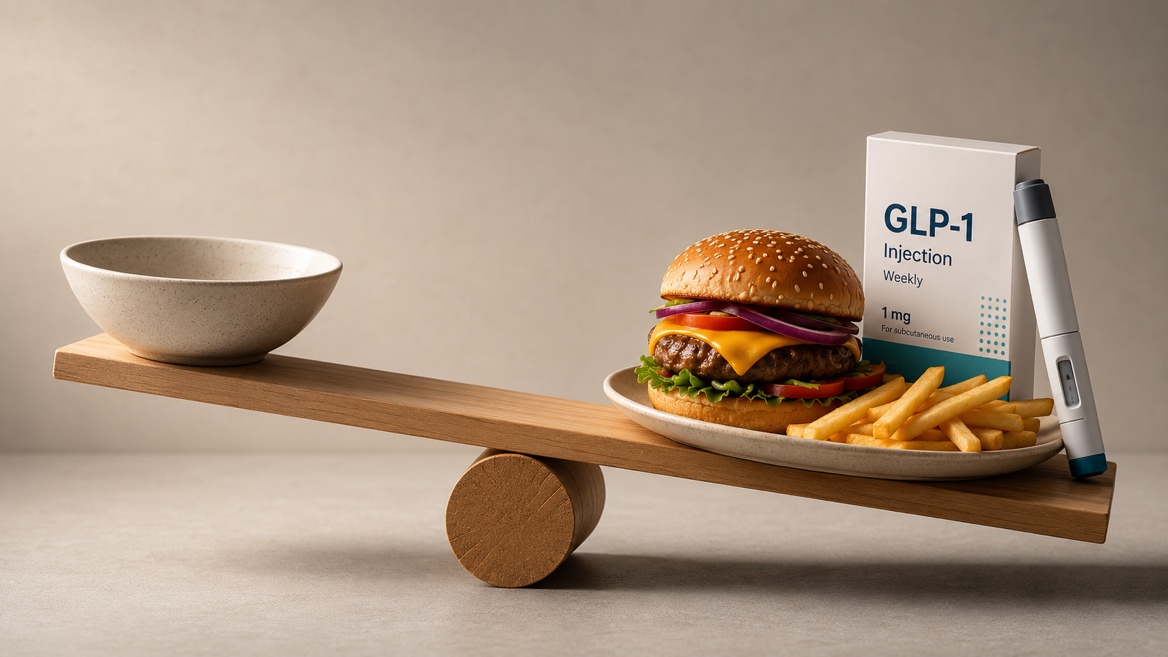
We spent 10,000 years defeating hunger. We now pay between 300 and 1,000 € a month to simulate it.
In 2024, 673 million human beings went hungry. Really hungry. The kind that wakes you up at night — not the kind that sends you to the fridge during Netflix.
At the same moment, at the other end of the table, a growing share of humanity is injecting itself with a weekly molecule whose primary function is to suppress appetite.
Welcome to the great nutritional divide of the 21st century: a world that can neither feed its starving nor satisfy its overfed.
The species that ate too much
Let's be honest: obesity is a disease, not a moral failure. I'm not mocking the sick. I'm puzzled by the system that creates them.
Because we — the food industry — are very good at what we do. We learned to make a product irresistible: the bliss point of sugar, calibrated crunch, salt that calls for more salt. Decades of R&D spent crossing the satiety threshold before the brain even notices.
The result: over one billion obese adults, trending toward 1.13 billion by 2030. The fastest growth? Not in Beverly Hills. In low- and middle-income countries — the very same ones that, on the map next door, are still counting their hungry.
The same continent, sometimes the same country, now houses both nutritional extremes. Quite an achievement.
The pen that erases our own work
Then came GLP-1.
So we have one industry — mine — spending fortunes making people unable to stop eating. And a neighbouring industry — pharma — spending fortunes making them able to stop.
The antidote to the food product, sold separately. A $150 billion market expected by 2035. That's roughly the GDP of several countries where people go hungry.
We invented abundance. Then we invented the drug for abundance. All we need now is the subscription model.
The species that didn't eat enough
While the West debates dosage, Africa counts 307 million hungry people — more than one in five. 2.6 billion human beings cannot afford a simply healthy diet.
Not a dessert. Not a supplement. Healthy.
And demographics aren't waiting: 9.7 billion humans by 2050, with most of the growth in Africa and Asia. To keep up, we'll need to produce 50 to 70% more food, on a warming planet with depleting soils.
The uncomfortable question
We know how to design a snack that sells itself. Can we design a calorie that genuinely nourishes those who lack them?
Because in our relentless optimisation of pleasure and our race to patent the brake, we forgot the point of the job: to feed people. Properly. Everyone.
The next great food innovation won't be more addictive, or more injectable. It will be more equitable. More nutrient-dense, less resource-hungry, accessible where hunger is still advancing.
Everything else is symptom engineering. And we're already very good at that.
So, colleagues in food: in 2026, do we keep refining the bliss point — or do we put nutrition back at the centre of the plate?