
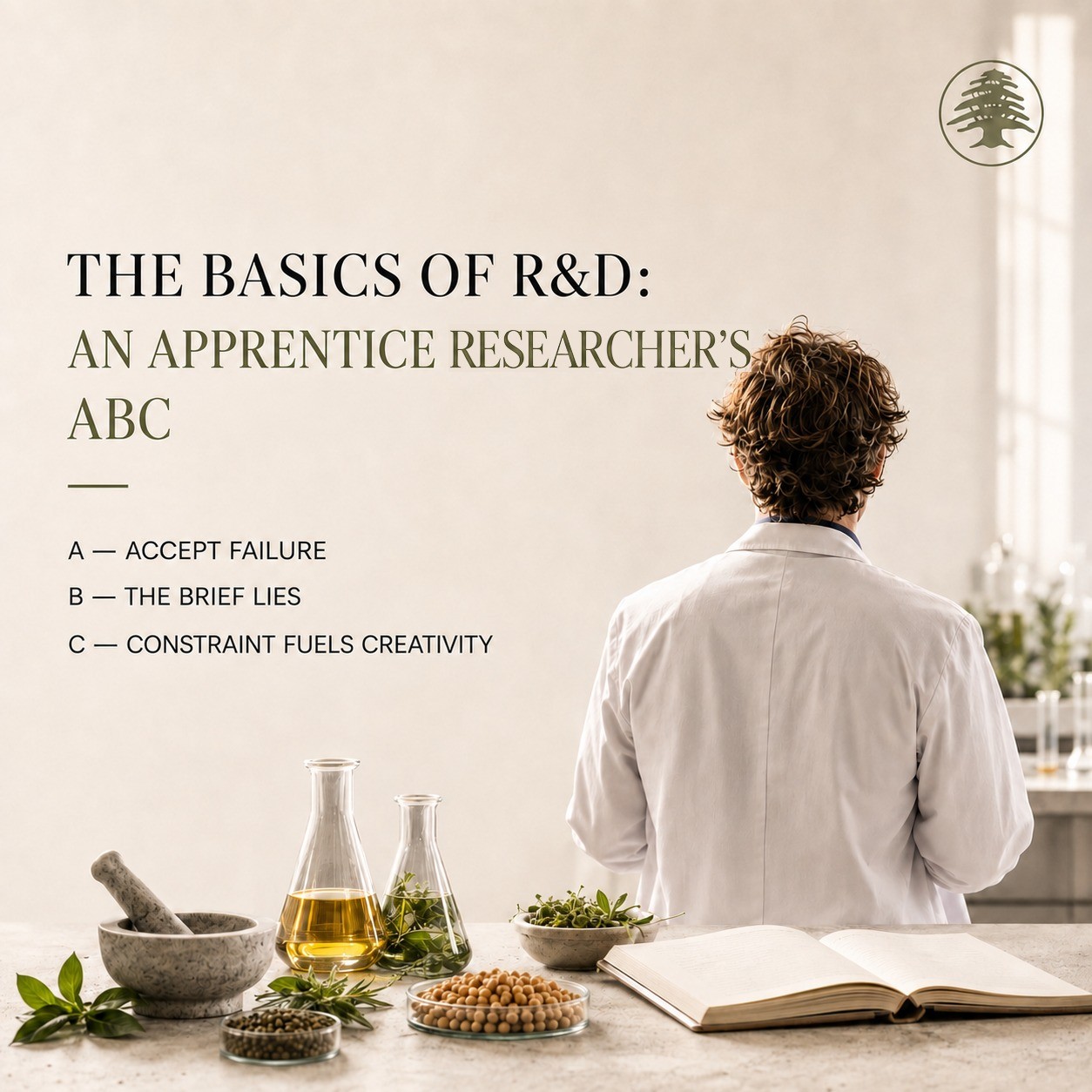
We picture the food scientist in a spotless lab coat, surrounded by smoking flasks, shouting “Eureka!” at midnight. The truth is less photogenic: three failures before the first coffee, a marketing brief that defies the laws of physics, and a yoghurt that exploded in the incubator overnight. Welcome to R&D. Here's the ABC no one teaches you at school.
A is for Accept failure.
The beginner thinks the job is to succeed. Wrong. The job is to fail — fast, cleanly, and taking notes. One formula in ten makes it out alive; the other nine go down the sink. The good researcher isn't the one who fails less, it's the one who fails more intelligently, and knows exactly why the mayonnaise split. Failure isn't the enemy. It's the rough draft.
B is for the Brief lies.
One day, someone will hand you a spec sheet. It will ask for a product that's “cheaper, healthier, more stable, more natural, and tastes like grandma's.” Grandma, mind you, had no quality department, no eighteen-month shelf life, and no cost-of-goods target. The brief isn't an order, it's a wish list. Your job starts the moment you dare to ask: “Which one of these five adjectives is truly non-negotiable?” The other four, we negotiate.
C is for Constraint.
We think constraint is the enemy of creativity. It's the opposite: it's the mother of it. With no budget, no allergens to dodge, no imposed production line, anyone can invent. The talent is making a great product with a spec that feels like a straitjacket. The blank page isn't freedom. It's dread.
That's the essence. The rest — the chemistry, the processes, the regulations — can be learned. Humility, reading between the lines, and a love of constraint, far less so.
A question for those of you who train young researchers: what's the first real lesson you wish someone had handed you on day one?